
Digital forensics has become a familiar theme in modern television and movies. From hit shows like CSI, NCIS, Criminal Minds, and countless other streaming crime dramas, audiences are shown investigators uncovering vital evidence from mobile devices, computers, digital videos, and online activity in ways that often seem instantaneous and flawless with just the push of a button. While these portrayals make for compelling entertainment, they also create misconceptions about what digital forensics actually looks like in real-world investigations and what might be realistically achieved.
Several network crime shows have given birth to what is called the “CSI effect”, which is the phenomenon where jurors’ expectations of forensic evidence, influenced by these crime shows, lead them to expect unrealistic results from digital examinations. This effect extends to digital forensics: jurors may believe investigators can recover deleted files instantly, trace an anonymous hacker within minutes, reconstruct entire conversations from damaged devices, and recreate high resolution images from mere pixels. While these abilities sound impressive on screen, they usually exaggerate or oversimplify the realities of forensic science.
In practice, digital forensic examinations are methodical, technical, and time-consuming. Analysts follow strict protocols to ensure evidence is admissible in court, and results are rarely as fast or conclusive as they appear on television.
There are, however, several examples in television and film where it was clear that an expert was consulted to lend some credibility to the storytelling. As someone whos’ career has spanned both film/television post-production and digital forensics, I always appreciate when these little easter eggs are included.
CSI: Crime Scene Investigation
Possibly the most infamous offender of unrealistic digital forensic methods and results, and with 337 episodes across 15 seasons, there are too many examples to list, not to mention all the spinoff (and I shudder to think what they came up with in CSI: Cyber). I recalled in one episode they take a video that’s streaming online of a concert, and they zoom in on the distant and poorly lit stadium seating to positively identify two individuals. Considering that in 2008, when that episode aired, even 720p video streaming was a rarity, and they were certainly not using the Hubble telescope to film this, so the results they got from the zoom and enhancement process were beyond farfetched.


CSI: Crime Scene Investigation, s9 ep 9, “19 Down…”
24
A common trope of the series 24 was for Jack Bauer to demand that Chloe “enhance” images over and over again until he got the desired result. If only we had the tools that Chloe seemingly had at her disposal, then we might be able to identify all those license plates that were too far away, over exposed, or streaked with motion blur that couldn’t be corrected with the advanced software we currently have.
In this episode Chloe also uses her “advanced” set of tools to analyze surveillance footage from a street camera and enhanced it to create critical, highly detailed evidence from almost nothing with the click of a button. What Chloe did certainly generated new content within the image, as there would never be enough pixel information to negate massive amount of interpolation, or the filling in of missing information. Furthermore, that enhancement is still beyond what even today’s most advanced generative AI tools can achieve reliably, and those models would be hallucinating more than my old college roommate at Burning Man.


24, s8 ep12, “Day 8: 12:00 p.m. – 1:00 p.m.”
The Lincoln Lawyer (Netflix series)
This example started off somewhat promising and then took a nosedive. In the Netflix series The Lincoln Lawyer, a crooked detective arranges a highly convenient traffic stop. A phone is taken from the back pocket of a detained person and secretly given to the detective who is told he’s only got 10 minutes. The detective then plugs the phone into a Cellebrite Touch 2 unit (no longer in production) to extract the data. The use of a Touch 2 is where the realistic use of digital forensics in the storytelling ends. When was the last time anyone did an extraction of any kind that took less than 10 minutes? To say nothing of the fact that they didn’t have a device passcode, what about the fourth amendment protecting the hapless floral delivery guy from illegal search and seizure?

The Lincoln Lawyer, s1 ep8, “The Magic Bullet Redux”
Clear and Present Danger (1994)
In Clear and Present Danger, there’s a scene where Jack Ryan and the intelligence team are analyzing intercepted cartel communications. They isolate a voice recording of drug lord Ernesto Escobedo and run it through an analysis system to compare it to a short 6-word statement left on an answering machine (“The machine is still on, Moira”). On screen, the machine quickly generates a spectrogram-like display and delivers a clear voice recognition match, confirming the speaker’s identity almost instantly.
Now I love me a Jack Ryan story, and I’ve read everything Tom Clancy has ever written, but this is yet another one of those “enhanced forensic tech” moments. Here’s what’s wrong with this picture. Speech to text existed only in a very rudimentary form in 1994 and was not anywhere near the capability of reliably identifying or authenticating individuals by voice. Forensic speaker identification was practiced, but it was much slower and heavily expert-driven with analysts comparing spectrograms by hand, looking for distinctive patterns. It was not a push-button database match like fingerprints. The scene depicts a computer instantly analyzing and matching a voice sample to a known speaker in a database. Furthermore, the “match” is presented as absolute, while in reality, forensic voice comparison is probabilistic, meaning experts can say voices are likely or unlikely to match, not that they definitely belong to the same person. So, when the analyst assures Jack the voice match is 90%, it is still 100% junk science.

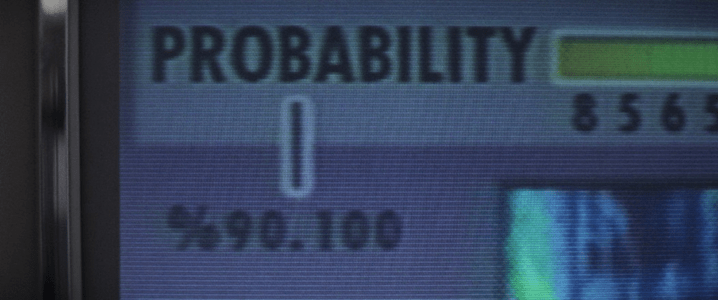
Clear and Present Danger (1994)
Mr. Robot
Mr. Robot is held up as one of the most authentic portrayals of digital forensics and hacking on mainstream TV. The show uses actual software such as Metasploit, nmap, John the Ripper, and command-line tools as part of the storytelling. Characters are shown using FFmpeg with command-line syntax to process video and audio files. FFmpeg is commonly used in digital forensic analysis for processing and examining multimedia evidence. Investigators use it to extract, convert, and analyze audio and video files without altering the original content.
In the episode “h1dden-pr0cess.axx”, s1 ep8, Trenton uses the following command:
ffmpeg -i fuxFBI.mp4 -map 0 -map_metadata 0:s:0 -c copy fuxFBI.mp4
What this essentially does is A) copies the video, audio, and subtitle streams exactly as they are, B) overwrites the file while transferring only the metadata from the first subtitle stream, and C) discard any other metadata (like camera info, creation date, software info). In effect the character is using this command to sanitize the file, removing identifying metadata while keeping the actual media intact.

Mr. Robot, s1 ep 8, “h1dden-pr0cess.axx”
Later in the same episode, the following command is used to target a video file, set a framerate of 24 fps, and output still frames to .jpg image files with a filename pattern of sequential three-digit numbers.
ffmpeg -i videocapture.mp4 -r 24/1 C:\frames\fuxFBI%03d.jpg
From a forensics point of view, perhaps a lossless format such as .PNG or .BMP is a better output choice.
Incidentally, can anyone explain why Elliot’s phone is always at 22% battery?
No Time to Die (2021)
In the modern James Bond films, Q has evolved significantly from the original “gadgets and tech support” archetype, and unlike the early films where gadgets were often whimsical and highly implausible (e.g.: perfectly invisible cars, instant code crackers, satellite EMP weapons), the modern Q tech does occasionally have moments grounded in reality. In No Time to Die, there is a Tableau TD2 duplicator sitting on his desk. Not flashy, but certainly an item that is proper for an analyst performing critical analysis of a hard drive recovered from the rogue scientist Dr. Valdo Obruchev. Perhaps Q found time to read the SWGDE Best Practices for Computer Forensic Acquisitions document.
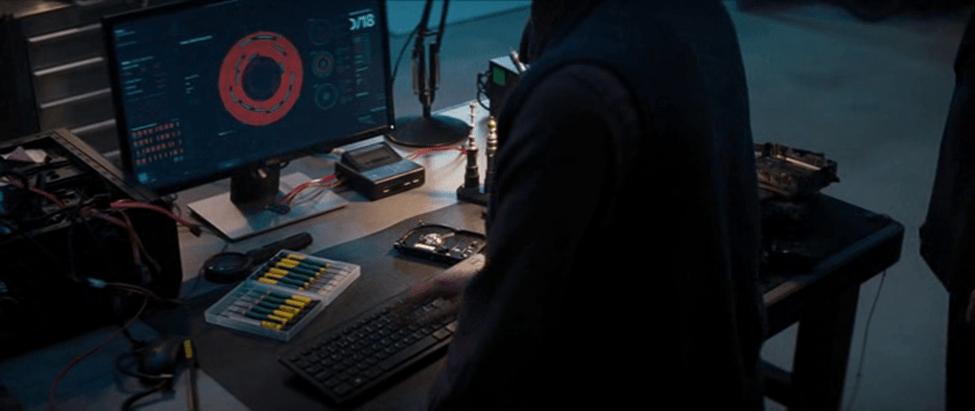
No Time to Die (2021)
In summary, the gap between fiction and reality highlights the importance of managing expectations in legal and corporate cases. Digital forensics can provide powerful evidence and be of immense value in court, but it is not magic and there is no single button tool to achieve results. For example, it is important to understand that deleted data is sometimes recoverable, but not always. Overwriting, encryption, and system activity may render information unrecoverable, particularly in the case of mobile devices. Further, timelines can often be reconstructed with the use of various digital artifacts, but not necessarily with the cinematic clarity that television and films often portray. And when it comes to audio, video, and image enhancement, this is almost never shown on screen with any degree of forensic accuracy, and this leads to the importance and value of having professional guidance.
Because of the complexity of digital evidence, it’s essential to consult with a trained digital forensics professional when questions arise. A qualified examiner can:
- Explain what kinds of data are realistically recoverable.
- Provide timelines for analysis based on the scope of a case.
- Testify in court with clear explanations that help jurors distinguish fact from fiction.
- Ensure evidence is collected, preserved, and analyzed in a way that stands up to legal scrutiny.
Speaking directly with an experienced professional prevents unrealistic assumptions shaped by film and television and ensures that investigative strategies are based on what is actually possible. Digital forensics has become a fascinating and valuable field, both in real life and in the stories we watch on screen. But while cinema highlights its intrigue, it also risks misrepresenting its capabilities. The “CSI effect” underscores why managing expectations is so important. By collaborating with trained professionals, attorneys and clients can separate entertainment from reality and make the most of what digital forensics can genuinely offer.


 The Metadata Perspective
Leave a reply to Week 35 – 2025 – This Week In 4n6 Cancel reply